The Tiny Meter That Ends the Holiday Lights Cost Debate
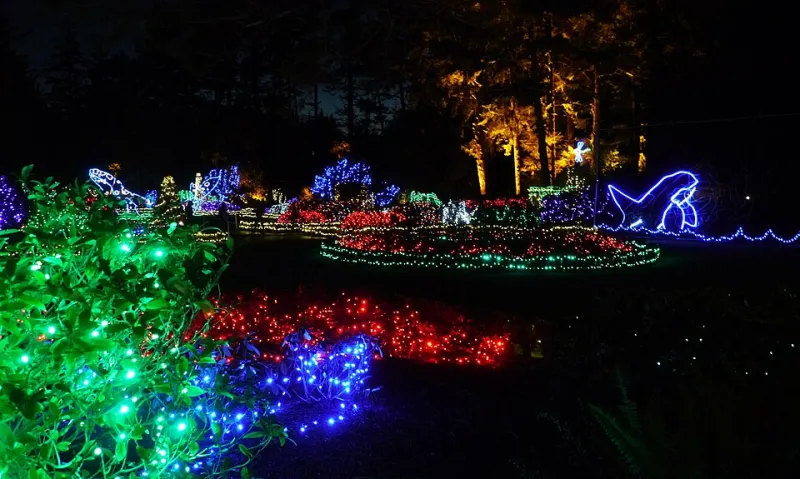
Photo: Rick Obst, CC BY 4.0, via Wikimedia Commons
Every year around Thanksgiving, someone in the house flips the switch on the first string of lights and asks the same question: are these things running up the bill? The answers are usually vibes. LED strings are cheap, incandescent strings are expensive, timers help, and nobody really knows the actual number. A plug-in power meter fixes that in about 15 minutes. No electrician, no spreadsheet, no argument.
Start With the Meter, Not the Box
A basic plug-in watt meter costs around $20 at most hardware stores or online. You plug it into the wall, plug the light string into the meter, and turn the string on. Give it a minute to settle, then read the wattage. That reading is the number that matters — not the marketing copy on the box.
A few practical notes. Measure the mode you actually use. If the string has eight blinking patterns and you leave it on the calm steady glow, measure that. If you use the chaotic chase mode, measure that instead. For strings with replaceable bulbs, make sure every socket has a working bulb before you trust the reading. A missing bulb can change the draw.
If your meter displays VA instead of watts, look for a watts setting or a power-factor reading. For simple resistive holiday lights, watts and VA are close enough for a household estimate, but watts is the cleaner number.
The Formula That Fits on a Sticky Note
Once you have watts, the math is simple:
Watts × hours per day × days in the month ÷ 1,000 × your electricity rate = cost
Your electricity rate is on your utility bill, usually listed as cents per kilowatt-hour. Many US households are paying somewhere near 17 to 18 cents per kWh right now, but use your own number. Rates vary a lot by state and by time of day.
Here is a real-world example. Say you have an older incandescent string that pulls 100 watts. You run it six hours a day for all 31 days of December:
100 × 6 × 31 ÷ 1,000 = 18.6 kWh 18.6 × $0.17 = about $3.16 for that one string
Now swap in a typical LED string that pulls 6 watts:
6 × 6 × 31 ÷ 1,000 = 1.12 kWh 1.12 × $0.17 = about $0.19
One string is not the whole story. Ten incandescent strings at that rate would run roughly $31.60 for December. Ten LED strings would run about $1.90. That is the kind of gap that ends a family debate quickly.
LED vs. Incandescent: The Gap Is Real, but Check the Label
The old rule of thumb is that LED holiday lights use 80 to 90 percent less energy than incandescent bulbs. That is broadly true for mini lights, but it is not a law of physics. Some LED strings use larger bulbs, extra controllers, or fancy features that pull more than a bare-bones set. A 100-bulb LED string might draw 4 to 10 watts, while an incandescent string of the same length might draw 40 to 100 watts. Measure before you assume.
Also check the wire, not just the bulbs. A string with a bulky controller or a built-in music sync feature can draw a little more. It is still likely far below incandescent, but the meter gives you the exact figure.
Where Daisy-Chaining Gets Risky
Holiday light strings are designed to be connected end to end, but every manufacturer sets a maximum. It is usually printed on the tag near the plug. Follow it. Do not connect five strings just because the plugs fit.
A few safety checks are worth doing while you are already crouched near the outlet:
- Look for a UL or ETL mark on the string. That means it has been tested to a recognized safety standard.
- Feel the plugs after the lights have run for 20 or 30 minutes. They should be warm at most, not hot. A hot plug is a stop sign.
- Do not run strings through door hinges, under rugs, or across walkways where they can be pinched or tripped on.
- Outdoors, use a GFCI outlet or a GFCI-protected extension cord. Keep connections off wet ground.
- If you need an extension cord, use a heavier gauge for long runs. A 16-gauge cord is fine for a short run; 14 or 12 gauge is safer for longer distances and bigger loads.
- Do not piggyback multiple power strips into one another. That is how you turn a festive display into a space heater.
Put the Whole Display on a Timer
A smart plug is the easiest upgrade. Plug the smart plug into the wall, plug the light string or a safe power strip into the smart plug, and set a schedule. A common setup is on at sunset and off at 11 p.m., or simply six hours after sunset. That eliminates the daytime burn when nobody is home and the forgotten overnight run when everyone is asleep.
The smart plug itself draws a small amount of power — usually a watt or two — so it is not literally free. But it is tiny compared to leaving a display on for an extra eight hours a day. If you want to be precise, measure the smart plug with your meter before you add the lights. Most people will find the convenience is worth it.
Group your display into zones if you have several strings. One smart plug for the porch, one for the tree, one for the yard. That way you can turn off the outside lights at 10 p.m. and leave the indoor tree glowing a little longer. Just do not exceed the smart plug’s rated wattage. Most are rated for 10 to 15 amps, but check the label.
A 15-Minute Audit You Can Do Before Dinner
Here is the whole process in order:
- Unplug the string you want to test.
- Plug the meter into the wall and the string into the meter.
- Turn the string on and let it run for a minute.
- Write down the wattage.
- Repeat for each different type of string in your display.
- Add up the watts, then run the formula with your own electricity rate and your actual hours per day.
The total is your December lighting cost. It may be $4. It may be $40. Either way, you will know. And when someone asks whether the lights are expensive, you can point at the meter instead of guessing.